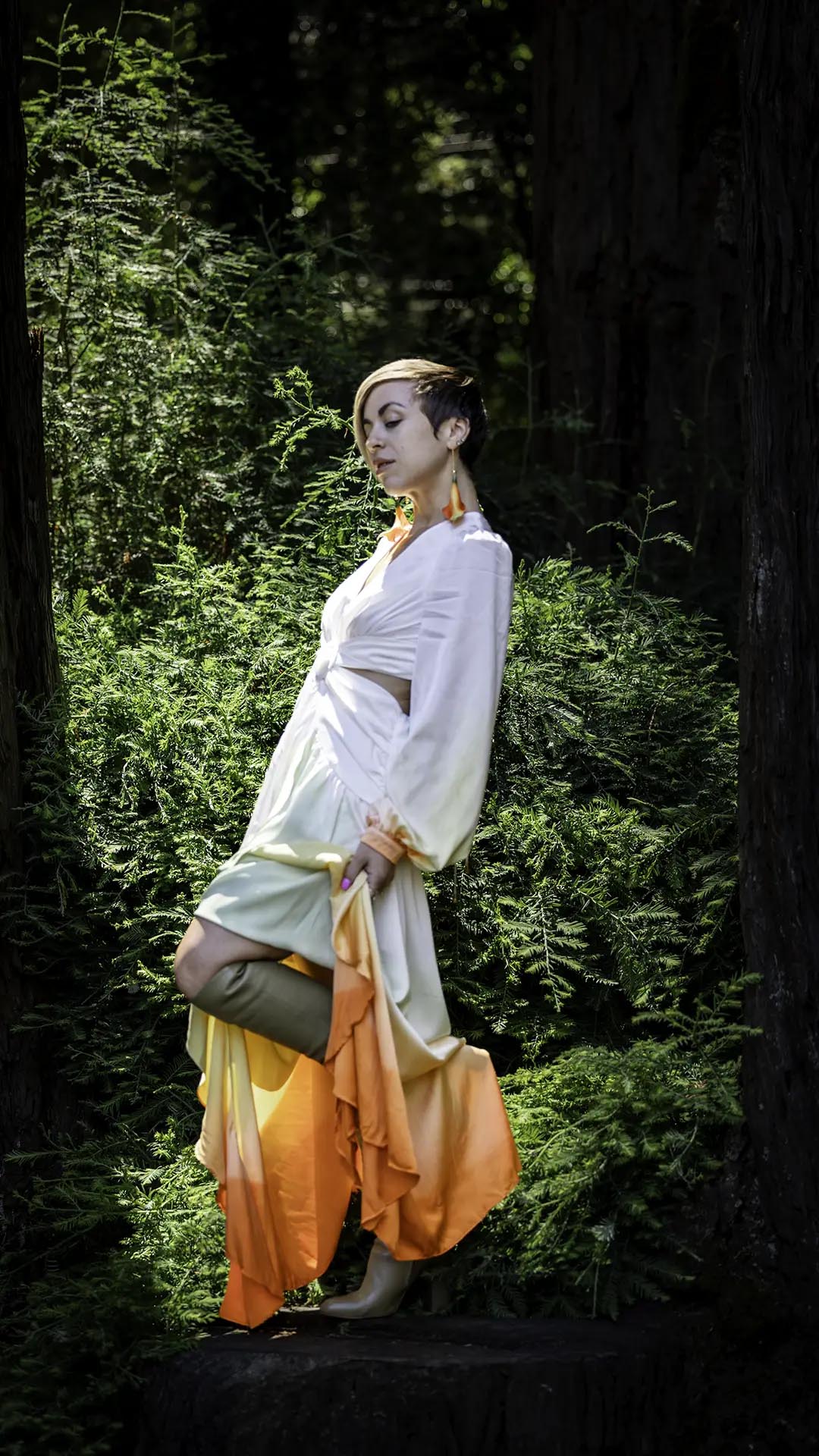
When and How to Overpower the Sun with Off-Camera Flash

Many photographers treat overpowering the sun as the ultimate test of outdoor flash. The technical result can be impressive: a bright subject, a dark sky, saturated color, and crisp separation. But making the sun look weak is not the goal of every portrait. A professional first decides whether dramatic flash or balanced natural light better supports the person and the story.
The useful question is not, “How much power can I produce?” It is, “What should this moment feel like?” Sometimes the answer is theatrical contrast. Sometimes the answer is quiet daylight with almost invisible fill. This guide explains how to make that decision, then build the exposure efficiently with Godox off-camera flash.
Estimated reading time: 13 minutes
> Product specifications were checked against current Godox documentation on August 1, 2026. Confirm the manual, firmware, trigger compatibility, and thermal limits for your exact equipment before a production session.
What Does “Overpower the Sun” Mean?
Overpowering the sun means intentionally recording the ambient scene darker than a natural meter reading, then using flash to expose the subject at the chosen brightness. The flash is not literally brighter than the sun at its source. It wins the local exposure contest because it is close to the subject while sunlight is controlled through camera settings, time, angle, shade, or filtration.
Five ideas shape the result:
Ambient exposure: The exposure created by sunlight and the environment without flash. Shutter speed, aperture, and ISO determine how it records.
Flash exposure: The light reaching the subject from the flash. Power, distance, modifier efficiency, aperture, ISO, and synchronization mode affect it.
Subject brightness: The combined result of ambient and flash on the person. The face may receive both sources in different proportions.
Background brightness: Usually governed mainly by ambient exposure because the flash is too far away to illuminate a distant sky, building, or landscape.
Dynamic range: The span between recoverable highlights and shadows. Flash can place the subject within that range while the background is held darker.
At normal flash synchronization speed, a practical starting model is simple: shutter speed changes the ambient contribution more than the brief flash contribution; aperture and ISO affect both; flash power and distance primarily change the flash-lit subject. Once high-speed sync is enabled, that separation becomes less clean because shutter speed also changes effective flash exposure.
Do not confuse “overpowered” with “correct.” A background one stop below a natural reading can still feel believable. Two stops may feel cinematic. Three stops can look stylized or artificial. The right ratio depends on skin, clothing, location, sky detail, color, and the emotional direction of the portrait.
When Should You Overpower the Sun?
Use a darker ambient exposure when contrast supports the assignment:
Editorial portraits: A controlled pool of light can turn an ordinary location into a scene with tension.
Athletic portraits: Harder flash, defined shadows, and a dark sky can reinforce strength, speed, and physical focus.
Fashion: Precise light can separate wardrobe shape, texture, and color from a visually active setting.
Commercial branding: A bold campaign image may need consistent subject emphasis and controlled brand color.
Dramatic skies: Underexposing ambient preserves cloud structure and sunset color while flash restores the face.
Harsh midday light: Flash can replace unattractive overhead facial light when shade is unavailable.
High-contrast environments: It can bridge a subject in shadow with a bright architectural or landscape background.
The technique is strongest when the heightened lighting feels intentional. A chef outside a dark restaurant, an athlete under a hard sky, or a musician on an industrial street may benefit from visual force. The same treatment can overwhelm a gentle family interaction or a quiet environmental portrait.
When You Should Not Overpower the Sun
Golden hour often provides direction, warmth, long shadows, and natural separation without a large flash-to-ambient ratio. Soft overcast light already wraps faces and preserves detail. Lifestyle portraits depend on movement and believable observation. Families need consistent coverage across several people. Environmental stories often require the location to remain luminous and emotionally present.
In these situations, use no flash, a reflector, or restrained fill. A small amount of flash can lift eye sockets, manage backlight, and stabilize skin exposure without announcing itself. Balanced light often feels more authentic because the subject still belongs to the weather, time, and place.
Natural-looking does not mean technically careless. Watch highlight clipping, face-to-background contrast, color contamination from foliage, and shutter speed. The difference is intention: the lighting supports presence instead of becoming the subject of the photograph.
Ambient First: The Professional Workflow
Step 1: Determine the Background Exposure
Turn the flash off. Frame the photograph and evaluate the important ambient elements: sky, architecture, landscape, practical lights, and reflective surfaces. Choose ISO for quality and working range, aperture for depth and story, and shutter speed for movement and ambient brightness.
Step 2: Choose the Mood
Decide whether the scene should feel open, natural, ominous, polished, athletic, romantic, or theatrical. Make a specific statement such as, “The clouds should hold detail, but the street should still feel like daylight.” That sentence is more useful than deciding to overpower the sun by default.
Step 3: Set Ambient Exposure
Adjust until the background matches that statement. Start near the meter reading, then test two-thirds, one, and two stops darker. Check the histogram and highlight warnings, but judge the emotional relationship as well. Protect important bright detail without turning midtones into empty black.
Step 4: Add Flash to Match the Goal
Place the flash for facial shape and story, not only convenience. Begin at modest power, make a test frame, and adjust flash power or distance until the subject belongs in the scene. Change one variable at a time. If the face looks pasted onto the background, reduce flash, soften the ratio, or let more ambient light reach the subject.
Professionals expose for the scene first because distant ambient elements cannot usually be repaired with a subject light. Once the environment is established, flash becomes a controlled layer rather than a rescue attempt.
Choosing Flash Power: V1 Pro, AD200 Pro, or AD600 Pro
Godox lists the V1 Pro at 76Ws. Its round head, portability, TTL/HSS capability, and on-camera option make it useful for close fill, open shade, golden hour, small modifiers, and fast-moving assignments. It can register against bright sunlight when close and efficient, but it has limited headroom for a large softbox, full-length framing, or a distant stand.
The Godox AD200 Pro is a 200Ws pocket flash with interchangeable heads and HSS support. It is a strong location compromise: significantly more output than a speedlight without the size of a 600Ws monolight. It works well for close three-quarter portraits, backlit golden hour, open shade, and many branding setups. In direct midday sun, use a compact efficient modifier, place it close, and avoid wasting output.
The Godox AD600 Pro provides 600Ws and is the practical choice when direct midday sun, a larger modifier, greater working distance, a group, or rapid sequences demand headroom. More capacity also allows the light to run below full power, improving recycle time and battery efficiency. The tradeoffs are weight, stand requirements, wind load, cost, and a more deliberate working pace.
Watt-seconds describe stored energy, not the exact light reaching the subject. Reflector shape, flash tube, modifier, distance, beam spread, HSS, diffusion, and placement all affect usable exposure. A close AD200 with an efficient reflector can outperform a distant AD600 behind multiple diffusion layers.
High-Speed Sync: Useful, Fast, and Expensive
High-speed sync allows compatible flashes and triggers to work above the camera’s normal synchronization speed. The flash emits a rapid series or extended train of light while the shutter slit crosses the sensor. That enables apertures such as f/1.4 or f/2 in daylight without immediately overexposing ambient light.
Advantages include flexible shutter speeds, shallow depth of field, easier movement control, and quick adaptation as ambient levels change. HSS is ideal when the portrait needs a wide aperture, the subject is moving, or adding and removing a filter would interrupt the session.
The cost is effective output. Energy is spread across the shutter travel instead of delivered in one efficient pulse. Faster shutter speeds generally require more flash power or closer placement. That means greater battery use, slower recycling, more heat, shorter sequences, and reduced working distance. Godox documents HSS up to 1/8000 second for these systems, but the maximum available speed is not automatically the best operating point.
Before enabling HSS, ask whether the aperture truly needs to be wide. Moving from f/2 to f/4 may provide enough depth, allow normal sync speed, and recover substantial flash efficiency. Review how aperture changes visual meaning in f/1.2 vs. f/11.
ND Filters: Keep Normal Synchronization
A neutral-density filter reduces the light entering the lens so a wide aperture can be used at or below normal sync speed. The flash can deliver its normal single pulse rather than HSS output. This preserves the flash’s most efficient operating mode, although the filter also reduces the flash light passing back through the lens. Opening the aperture compensates for that reduction while maintaining the desired depth of field.
ND filters are useful for deliberate portraits with stable light, a wide aperture, a fixed composition, and enough time to meter carefully. They can be preferable when HSS would leave insufficient power through a modifier or at the required distance.
Tradeoffs include slower handling, darker viewing, possible autofocus difficulty, color shifts, uneven polarization or density in some variable filters, flare, added glass, and the risk of stacking too much filtration. A fixed high-quality ND filter is generally more predictable than an inexpensive variable filter. Recheck white balance, focus, and reflections after attaching it.
Choose HSS for speed and changing conditions. Choose ND for a controlled setup where normal-sync flash efficiency matters. Choose a smaller aperture when neither tool improves the story enough to justify the complexity.
Modifier Choice Outdoors
Modifier — Character — Efficiency — Wind — Best use
• Softbox — Gradual transitions and controlled spill — Moderate to low after diffusion — High wind load — Portraits needing soft direction close to the subject
• Beauty dish — Defined, focused, editorial light — Moderate to high — Moderate wind load — Fashion, athletes, structured faces
• Standard reflector — Hard, efficient, directional — High — Low wind load — Maximum reach and dramatic midday work
• Bare flash — Broad and hard without reflector control — Variable — Low — Close experimental light or use with purpose-built accessories
• Grid — Narrows spill and protects background contrast — Reduces coverage and some output — Depends on host modifier — Precise placement and dark environments
Softness comes mainly from apparent source size relative to the subject. A large softbox far away may become hard while wasting power. Bring it close enough to matter, feather it for facial transition, and keep it outside the frame. A beauty dish offers more definition and often better efficiency. A reflector concentrates output but produces hard shadows that must suit the concept.
Outdoors, safety can decide the modifier before aesthetics. Large surfaces become sails. Use rated stands, ballast, level ground, and an assistant with hands on the stand. Lower the light immediately when gusts become unsafe. Compare the visual options in Octagonal Softbox vs. Beauty Dish vs. Umbrella.
Real Shooting Examples
Midday Senior Portrait: AD600 + Octagonal Softbox
Place the sun behind or three-quarters behind the senior to avoid squinting. Expose the sky roughly one stop darker, then place the AD600 and octagonal softbox close at about forty-five degrees. The 600Ws headroom offsets diffusion and allows a full-length or three-quarter crop. Keep the result appropriate to the person: dramatic enough to feel cinematic, not so hard that the portrait becomes a lighting demonstration.
Golden-Hour Branding Portrait: AD200 + Softbox
Preserve the warm sky and luminous environment. Use the AD200 close through a compact softbox as subtle key or fill. The flash may sit only a fraction above ambient on the face. Overpowering the sunset would remove the time-of-day cue that makes the branding image inviting. For framing decisions, compare 70–200mm vs. 50mm.
Editorial Athlete: AD600 + Beauty Dish
Expose for cloud texture or hard sky color, then use a beauty dish above and to the side for defined facial structure and body shape. The more efficient, focused modifier preserves output and creates a graphic shadow edge. A grid can reduce spill if the background must remain dark. Watch reflective clothing and skin highlights.
Business Owner Outdoors: Balanced Flash
For an approachable business portrait, expose the storefront or work environment naturally and add enough flash to open the face. An AD200 with a softbox often provides sufficient control. The subject should feel present in a real place, not cut out from it. This restrained approach supports personal branding photography.
Sunset Silhouette: Rim Lighting
Expose for the sky and allow the subject to become a silhouette. Place a flash behind or beside the person only if an edge is needed to clarify shape. The flash does not need to overpower the sunset or illuminate the face. A controlled rim preserves mystery while separating dark clothing from the landscape. See Rim Light vs. Background Light.
Common Mistakes
Trying to overpower every sunset: Darkening beautiful light removes the atmosphere that made the location valuable.
Using HSS unnecessarily: A smaller aperture or normal sync speed may recover output, battery life, and faster recycling.
Ignoring modifier efficiency: Multiple diffusion layers can consume the power needed to reach the subject.
Standing too far away: Flash exposure falls rapidly with distance. Move the source closer before demanding maximum power.
Choosing a modifier too large for the available flash: Apparent softness means little if the source cannot reach the required exposure.
Ignoring wind: No portrait is worth an unstable stand or falling light.
Over-lighting the subject: A bright face against an implausibly dark scene can look pasted in.
Mixing color carelessly: Late sunlight and flash may differ. Decide whether to neutralize, gel, or embrace the contrast.
Changing several variables at once: Adjust ambient, flash, position, and modifier separately so the result remains understandable.
Reading the LCD instead of the histogram: Screen brightness changes perception. Check clipping and evaluate on a calibrated display when possible.
Frequently Asked Questions
Can a Godox AD200 overpower the sun?
It can in favorable conditions: place it close, use an efficient reflector or compact modifier, keep the sun from striking the face directly, and work near normal sync speed. In hard midday light, a large diffused modifier or HSS may reduce its effective output too far.
Is a Godox AD600 always necessary outdoors?
No. Its 600Ws capacity provides useful headroom for midday sun, larger modifiers, greater distance, groups, or faster recycle at reduced power. Golden hour, open shade, close placement, or subtle fill may need only an AD200 Pro or V1 Pro.
Should I use high-speed sync or an ND filter?
Use HSS when shutter-speed control, movement, or rapid changes matter. Use an ND filter when you want a wide aperture while retaining normal flash synchronization and can accept slower handling, filtered viewing, possible color shift, and the need to focus carefully.
Do I always need maximum flash power?
No. Maximum power slows recycling, uses more battery, can increase heat, and may make expression changes harder to catch. First move the light closer, choose a more efficient modifier, improve the sun angle, or reduce the desired ambient-to-flash ratio.
What modifier works best for overpowering sunlight?
An efficient standard reflector or compact beauty dish produces more usable output and resists wind better than a large softbox. A softbox is appropriate when its softer transitions matter more than maximum reach and it can be secured safely.
Can a speedlight overpower the sun?
A V1 Pro or similar speedlight can create visible key light at close range, especially in shade or late-day conditions. It is usually a poor choice for full-length midday portraits through a large modifier because distance, diffusion, and HSS consume limited output.
How dark should the background be?
There is no fixed rule. Start near the meter reading, then lower ambient exposure by roughly two-thirds to two stops while watching the histogram and the emotional effect. Stop when the scene supports the subject instead of looking artificially dark.
Does shutter speed control flash exposure outdoors?
At or below normal sync speed, shutter speed mainly changes ambient exposure while aperture, ISO, flash power, modifier, and flash distance govern the flash-lit subject. In HSS, shutter speed also affects effective flash exposure because the flash pulses across the traveling shutter slit.
Why does my flash look weak in high-speed sync?
HSS spreads the flash energy across a longer emission as the shutter slit travels. Effective output falls as shutter speed rises, so moving from normal sync to a very fast shutter can cost substantial working distance or require more power.
Can I overpower the sun with a large softbox?
Yes, if the flash has enough output and the modifier is close. Large diffusion panels absorb light and become hazardous in wind, so use rated support, ballast, and an assistant. Reduce modifier size when safety or output becomes marginal.
Where should the sun be placed in an outdoor flash portrait?
Backlight or three-quarter backlight often keeps direct sun off the face and lets flash shape the subject. Side sun can create graphic contrast. Front sun is workable but may cause squinting and competing shadows. Choose the angle for story and comfort.
Is overpowering the sun realistic for family portraits?
It is possible, but often unnecessary. Families benefit from natural movement, comfortable expressions, broad coverage, and quick sequences. Open shade, backlight, or restrained fill generally feels more authentic and is easier to keep consistent across several people.
Story Before Power
Overpowering the sun is a creative choice, not a technical requirement. Determine the mood first. Decide whether sunlight should dominate, cooperate, or become a darker background layer. Then establish ambient exposure and add only the flash needed to make the subject feel present.
Continue with How to Choose the Right Godox Flash, Portland portrait photography, and the Photography Journal. Learn about Shayne Blaylock, or contact Shayne to book a portrait session or ask about one-to-one photography mentoring.